

REALTECH News, August 2026
Your monthly guide on deeptech geopolitics

Hi all, hope you’re all well. I’d love to hear from you also - let me know what you’re working on by replying to this email
This month we’ve got analysis on;
The AI debate; why open v close is the wrong focus. How AI looks more like a hardware business than software
Robot hands update from 1X, Gen-1 and Black Forest Labs
China’s roadmap to EUV lithography
📣 Public Service Announcements
🧑🏼🔬 Research: We released our Deeptech Geopolitics 2026 Report, a 100-page guide to everything happening across AI, robotics, manufacturing, defense and energy
Robotic hands update
Robotics hand progress has been an inhibitor of the humanoid story, this month saw multiple updates. 1X released a hand for NEO, a 25-degree-of-freedom, tendon-driven hands, with some interesting engineering decisions.

Low gear ratios make every joint force-transparent and backdrivable, so the hand feels what it touches rather than commanding blind positions, with tactile skin reading pressure and shear to catch a slipping object mid-slip. The demos run from picking individual screws and coins to plugging in a USB-C charger:
They are producing hundreds of units already, off a dedicated production line, with capacity for 10,000 hands a year, with most components built in-house. 1X’s framing is that the hardware ceiling is now gone and data is the only remaining barrier to capability, which history tells us is unlikely to be true.
The intelligence side also moved in step. Generalist AI‘s GEN-1 now drives a broad range of end effectors, trained on more than half a million hours of real interaction data across roughly 9,000 gripper and tool variations, on the logic that hands change, physics does not. Swap the end effector (eg hand, gripper) mid-task and the same model perceives the new hand and re-plans on the fly, pointing at an explosion of potential form factors rather than a five-fingered skeuomorphism.
Black Forest Labs in partnership Mimic, meanwhile, showed the world-model thesis paying off commercially: an early version of FLUX 3, the same multimodal backbone that generates video, is running robots on Audi production lines via FLUX-mimic, handling the soft seals and cables conventional automation could never touch, with reaction times of 101ms on a single RTX 5090.
The AI model race; why open v closed is the wrong debate
The arguments raging across the feeds this month, open versus closed, US versus China, whose model topped which benchmark, are for the most part a distraction. The interesting story sits at a different level to the model, in the prevailing AI diffusion policies of the two superpowers. Washington and Beijing are running opposite strategies for pushing AI into the real economy, and each is playing to a strength it already holds.
The gap closed again
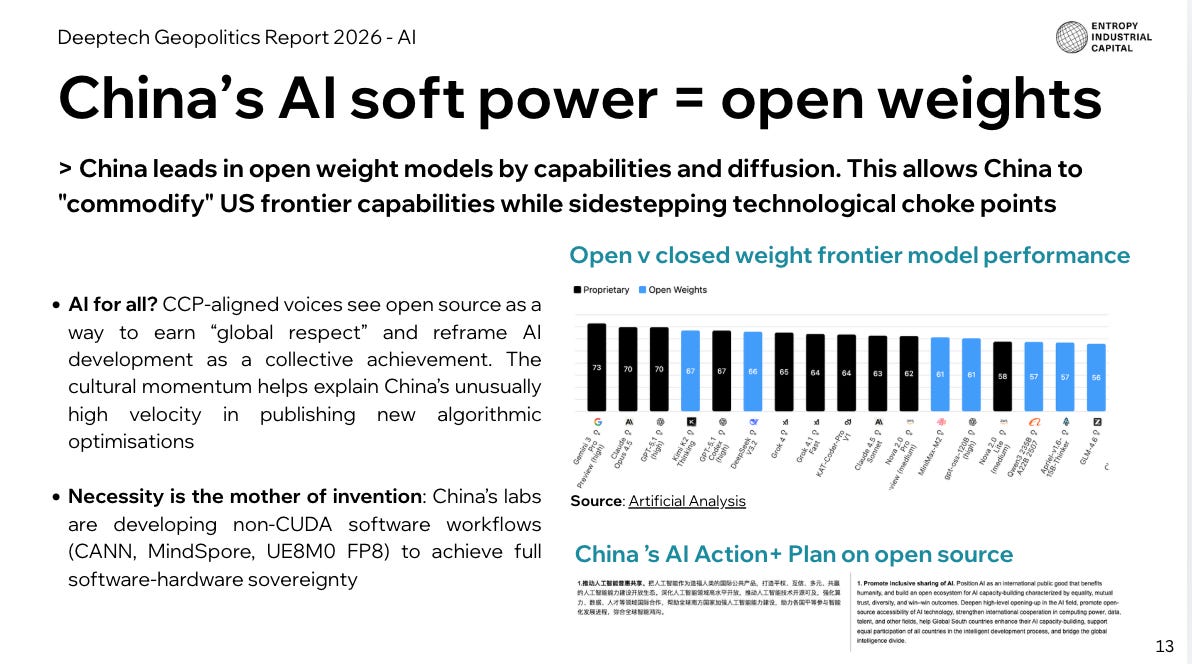
In the Deeptech Geopolitics Report we called China’s open-weight strategy its AI soft power, a way to commodify US frontier capabilities while sidestepping technological choke points, and flagged “The Flip”, the point in mid-2025 when cumulative Chinese open-weight downloads overtook American ones. Chinese models now account for an estimated 50-60%1 of global token usage, up from 1% in 2024, and Western companies are deploying them in production because they focus on $/token and the ability to fine-tune.
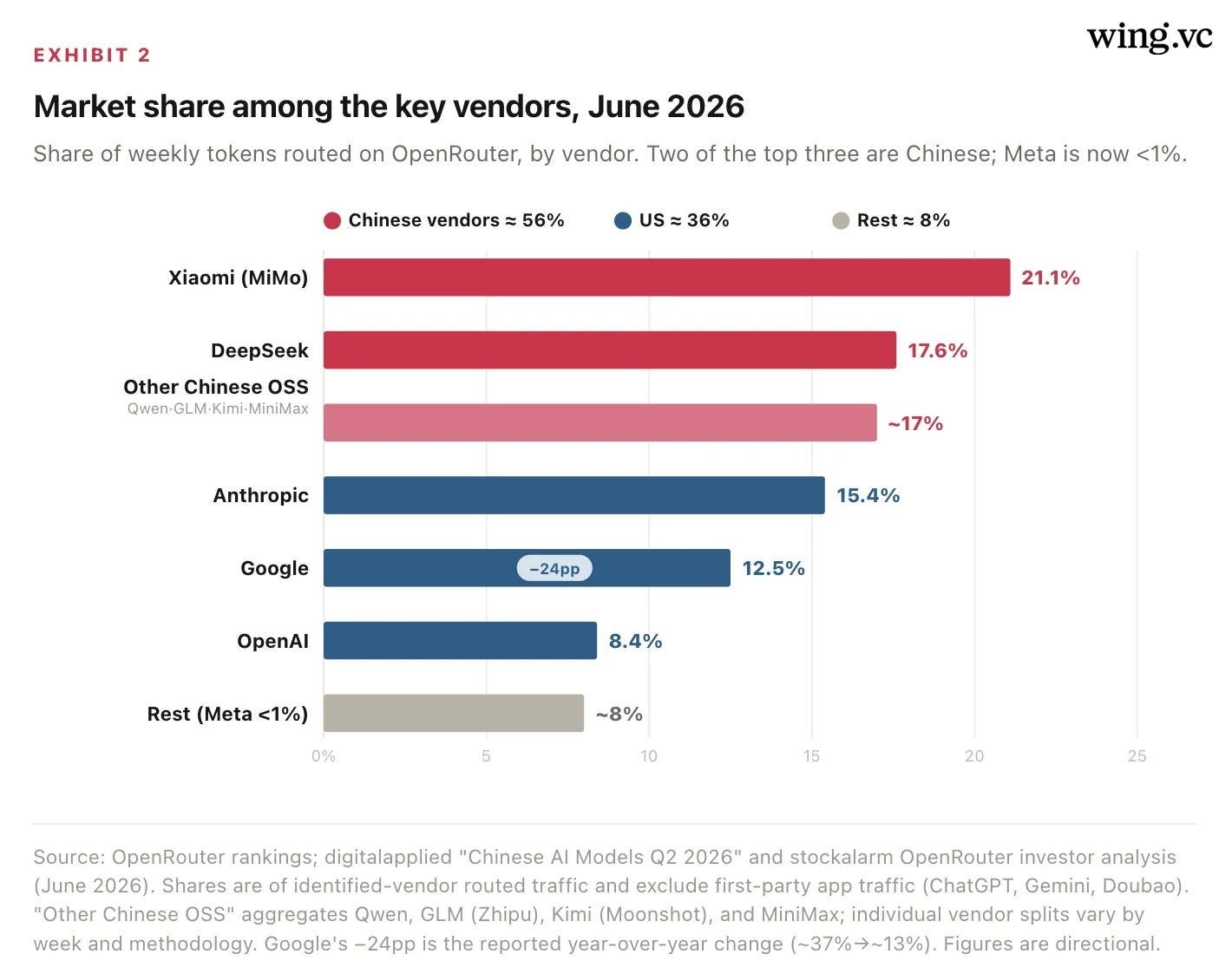
This month the gap narrowed again. Moonshot AI shipped Kimi K3 on 16 July, a 2.8 trillion parameter open-weight model that landed #2 on the Vals index and #3 on Artificial Analysis, behind only Claude Fable and GPT-5.6 Sol Max while undercutting both on price. Days later, Alibaba announced Qwen 3.8 Max would follow the same open-weight path, a notable reversal from a company that kept its largest models locked behind an API until this year. A gap that was pegged at 6-9 months last year now looks closer to 3-5 months. The correct reading of this is not that China is winning the model race, but that China is proving the model race no longer decides anything. When the frontier is a few months from being free, the frontier stops being the prize.
AI is a hardware business
Much of the commentary treats open weights like traditional software, downloaded once and served at near-zero marginal cost. The economics of AI are closer to a hardware business. The weights, open and closed alike, are R&D, a fixed cost that does not care what revenue you do. Inference is COGS, real and recurring and scaling directly with every token served, which means an open model is only free on one line of the P&L.
Nor are tokens a commodity. Kimi lists at $3 and $15 per million tokens against Sol’s $5 and $30, then burns considerably more reasoning tokens to reach the same answer, which quietly erases the discount. The fungible unit is intelligence rather than tokens, and the COGS of intelligence is a hardware stack. From model footprint, inference efficiency through MoE, memory efficiency in the KV cache, serving efficiency through batching and prefix caching, and token efficiency. In other words, racks, power and utilisation, not open weights.
China’s AI socialism: give away the model, enable the factory
Xi Jinping made a notable speech on AI at World AI Conference (WAIC) in Shanghai, his first in-person keynote at the event and his most detailed remarks on AI to date. He recommitted China to open source and tied it directly to AI:
“moving from the digital world into the physical world”
This is China’s core strength. Free models compound the lead China already holds in robotics, manufacturing and industry, the classic commoditisation of a complement (model layer) executed at national scale.
China continue to diffuse AI into the Belt and Road project. Including, 5,000 AI training places for developing countries over five years, cooperation centres with ASEAN, the Arab League, the African Union, CELAC, the SCO and BRICS, the MAZU weather-warning system for 30 countries. China is building rails into the Global South with the models thrown in for free.
As we noted in our Report, constrained GPU access has pushed Chinese labs toward algorithmic efficiency and non-CUDA workflows (CANN, MindSpore, UE8M0 FP8), full software-hardware sovereignty as a by-product of sanctions.
America’s bet: fence the frontier
The US bet is the mirror image, resting on the assumption that value stays at the model layer, and the US is trying to own that layer, wall it off and manage diffusion. It is capturing market share and revenue, whilst flirting with regulatory moats. It is worth noticing what the US is not doing.
The price umbrella underneath pricing power at the model layer is real, but conditional. Frontier demand exceeds supply, supply is capped by compute, and margins across the stack reflect it. Nvidia earns enormous margins, SpaceX resells compute to Anthropic at a markup, and Anthropic marks up tokens on top. US labs likely hold the lowest true cost per unit of frontier intelligence on capability, serving scale and token efficiency, and Chinese models look cheap in large part because scarcity lets American labs price far above cost. That umbrella holds exactly as long as compute remains a bottleneck.
The fencing, meanwhile, keeps escalating. The US Department of Commerce has weighed adding Chinese frontier labs to the Entity List, an executive order was floated making US hosts of Chinese models liable for their security, and draft supply-chain rules have circulated. The US FFC just banned Chinese humanoid robots from sale in the US. Bessent told CNBC the administration has “the ability to sanction them” over IP theft. At the same time 230-plus companies, Nvidia, Microsoft, Meta, Google and OpenAI among them, signed a letter urging Washington against premature restrictions. Anthropic was notably absent and issued its own statement.
The argument that open models are cheaper and therefore the frontier labs are cooked misses the point. OpenAI and Anthropic sit on vast compute capacity and can serve the entire AI stack to enterprises at a scale and reliability that a downloaded weight file cannot match. That is part of the moat alongside brand, not the model purely, being a trusted vendor with the ability to rack the GPUs and deliver the inference.
Two bets, one winner
China is betting that intelligence becomes infrastructure, cheap and everywhere, and that the physical economy on the far side of it is the prize. America is betting that intelligence stays scarce and premium, and that owning the frontier is enough.
If value migrates to the physical layer, the winners are whoever owns the industrial capacity, compute, energy and serving infrastructure underneath it. That is not a US-China binary, and it is the line Europe should pay attention to. Open weights are precisely what allow a middle power to build sovereign AI without training a frontier model from scratch, and the contested layer sits exactly where sovereign industrial policy already operates.
For no good reason - an oddly satisfying video of a robot running down a mountainside:
🤓 Stories you need to know
Agility Robotics is going public via a SPAC merger: ✅ one of our 10 predictions from our annual report happened (TechCrunch)
A forecast of Chinese EUV and DUV: a detailed piece with informed estimates of when indigenous EUV machines might be operational in China (AI Futures)
Reshoring the semiconductor industry risks failure (EE Times)
🇬🇧 Letter: Britain’s AI sovereignty lies with work frontier labs won’t do (Geraint Rees at UCL)
How much is robot training data worth? Not much! (Chris Paxton):
ASML’s Extreme Ultraviolet Lithography and the Limits of Reverse Engineering in China (War on the Rocks)
That's all this month. If you enjoyed the newsletter, please share it with your most brilliant friend!